Reads the offer
Reads the details shown on your Uber or Lyft offer card.
“I don’t worry about people tipping anymore. If they do, they do. With Is It Worth It?, I’m getting paid what I’m worth up front — so tips are just icing on the cake.”
Know before you accept.
The ride-offer verdict for Uber & Lyft drivers.
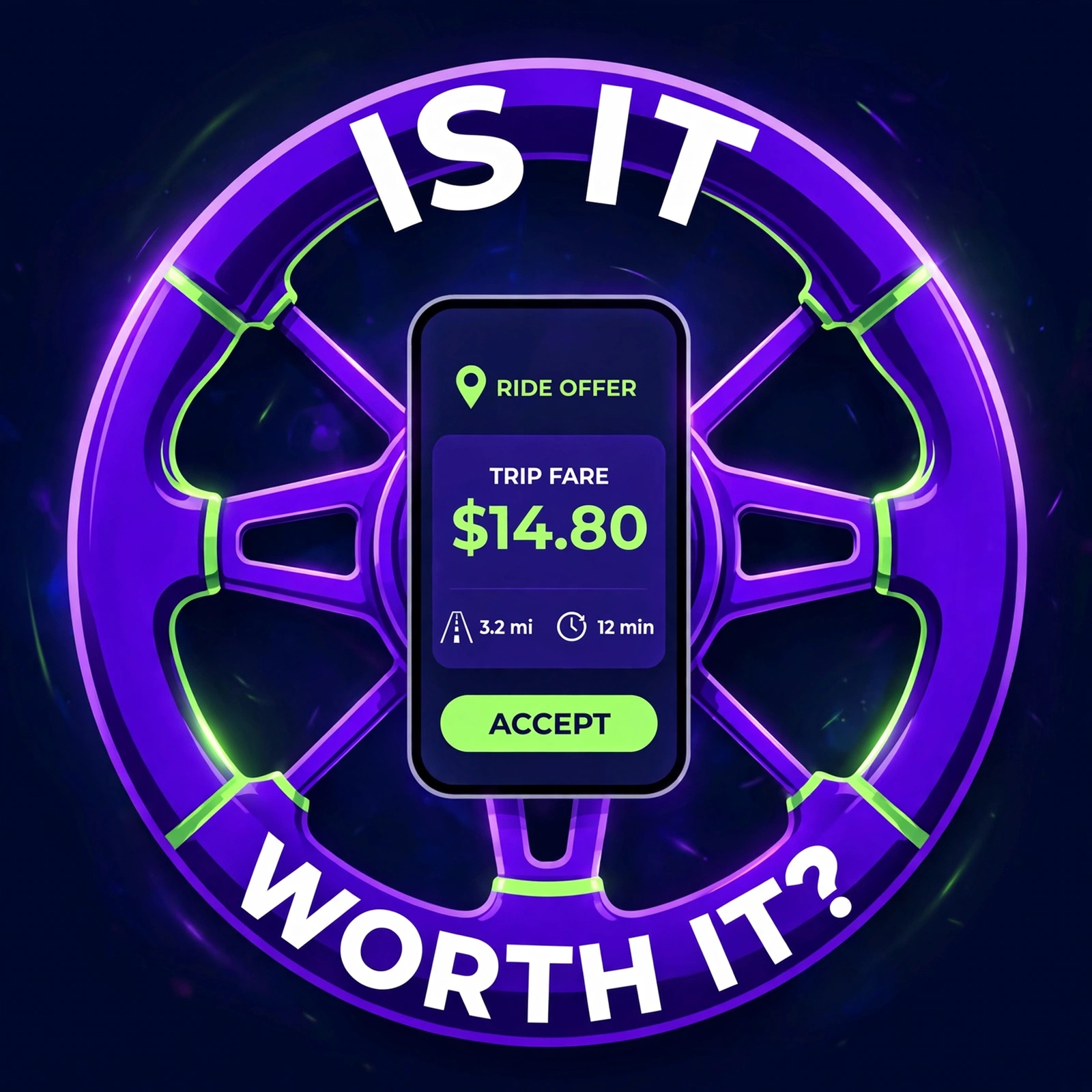
Hear the founder story, then see 20+ features in a fast, frame-by-frame walkthrough.
Tap play for the narrated explainer. Runtime: 2 minutes, 33 seconds. Sound is controlled by your device.

James has spent 11+ years driving for Uber and 9+ years for Lyft around Fort Collins, Colorado. Is It Worth It? isn’t a startup’s guess at what drivers need — it’s the tool he wanted in his own car, built from thousands of nights of staring at offer cards and asking the question every driver asks: is it worth it? His rule is simple: “Earning more money is not on the company to pay us. It’s about us making the proper decisions.”
Set what a worthwhile offer looks like. Then get a verdict without doing the math in your head.
One of the biggest complaints we get is drivers looking at incoming offers while driving with a passenger. This could account for bad ratings and complaints from riders and could get the driver deactivated! Keep your eyes on the road and let Is It Worth It? do the work!
Reads the details shown on your Uber or Lyft offer card.
Checks the offer against the standards you choose—not somebody else’s idea of a good ride.
Gives you a spoken verdict with a clear green or red badge.
The real controls, organized the way a driver needs them.
Your rules never stop you from accepting a ride — they just tell you the truth about the offer before you decide. You always make the call.
Turn up to five spoken details on or off.
Drop a pin, set a radius — get warned when a dropoff falls outside your area.
Your call: leave it on and get warned, or turn it off and drive anywhere.
Your area. Your radius. Stray outside it and the app warns you.
Set your radius anywhere from 1 to 100 miles.
Is It Worth It? launches January 1, 2027 with Uber and Lyft — the platforms it has been tested on, ride after ride. Offer verdicts for the rest are on the roadmap, labeled plainly: coming soon means coming soon, until they've been tested too. Straight talk, no oversell.
Ride offers and Trip Radar, read and called by your rules — field-tested nightly.
Ride offers read and called by your rules — field-tested nightly.
Delivery-offer verdicts — in the works, not yet tested. It joins the list when it earns it.
Offer verdicts on the roadmap for after launch.
Offer verdicts on the roadmap for after launch.
Offer verdicts on the roadmap for after launch.
Offer verdicts on the roadmap for after launch.
Offer verdicts on the roadmap for after launch.
Gig work doesn't stand still, and neither do we. New platforms get added as they're tested — never before.
Help us build the delivery side — and get it free. Is It Worth It? launches January 1, 2027 with Uber and Lyft. Uber Eats comes next, then DoorDash, Grubhub, and the rest — each built from real delivery cards, sent by real drivers. That’s where you come in.
Run the card collector on your real shifts. It saves the delivery offers on your screen so we can teach the app your platform — and when it gets a call wrong, one tap sends us what it saw. It only reads your screen. Never taps or accepts. You stay in control.
There’s no application and no minimums — every delivery driver in the US is welcome. Create your account before July 11, 2027 and it’s free until July 11, 2027. If your app isn’t fully built yet, you stay free until it is — the whole toolbox included — then 30 days free and the $7 early price, locked for life.
One catch, and it’s only fair: if even one app you drive for already works fully in Is It Worth It?, you’re a regular subscriber once the free window ends — one working app means the app is working for you. The free wait is only for drivers whose apps aren’t built yet.
And drivers who help build — who send cards and help teach the app their market — get the first option to become a founder in their area when a founder seat opens, if approved and you meet the minimum requirements. The seat is the top of the ladder for the drivers who helped build this.
Drive for a coming-soon platform? The verdicts for your app aren't ready yet — but the rest of the toolbox is, from day one: IRS mileage log, expense tracking, shift earnings, tax set-aside estimator, maintenance reminders, and Medicaid Work Proof work for every gig driver, no matter which app you run.
Run the work like a business, without turning every shift into paperwork.
Clear, rule-based guidance when a new ride hits your screen.
Track business miles for cleaner records at tax time.
Keep the costs of driving organized in one place.
See what the tank is costing and how efficiently you’re running — and get flagged when a tank’s MPG falls off your average.
Know your dollars per mile and dollars per hour. Forgot to end a shift? You can edit the logged miles and earnings total afterward.
Estimate what to reserve before tax season arrives.
Service countdowns for oil, tires, and brakes — plus warranty warnings — are live. Renewal-date reminders (registration, insurance, emissions) are still in testing.
Bring in records from Gridwise, Stride, or Everlance.
Photograph receipts before they disappear into the glove box.
New federal rules start January 1, 2027: many adults on Medicaid (ages 19–64) will have to prove they work — 80 hours a month, or at least $580 in earnings — to keep their coverage. Driving counts, but only if you can prove it. This rolls your tracked shifts into a monthly proof sheet — days worked, hours, and earnings, with both tests plainly marked MET or NOT MET — and exports it in one tap. Opt-in, stays on your phone, and the state makes the final decision. Don’t take our word for it — read the rule from CMS, the federal Medicaid agency.
Talk with a rider in their language: tap, speak, and the app answers out loud. Spanish is field-proven; nine more languages are on board. Nothing is recorded.
Runs Uber and Lyft like a relay. When an offer lands on the app in back, that app steps forward so you see it. Accept a ride, and the app speaks up — don’t forget to turn the other one off — and brings it forward so you can. Once it’s off, you’re flipped back to the app with your live ride on it. The panel’s flip button swaps you by hand anytime.
One tap on the panel’s green $ button speaks your combined Uber and Lyft total out loud — no adding in your head at a red light.
Weekday numbers and weekend numbers, each with its own days. The app locks the right set when your shift starts — and one tap switches sets for tonight.
Uber Trip Radar offers get pulled forward and judged by your rules, same as any offer card.
Automatically reads the quest right off Uber's bottom bar and fills in the quest section itself — nothing to type, nothing to enter by hand. Then it counts down as your rides land.
Pick your home app and it stays in front while you work. Switch away by hand and it comes back after 2, 4, or 6 minutes — your choice.
A first-of-the-month nudge to cash in your Lyft tier points in the Lyft Shop before they sit too long. Field-proven on its first month-start firing.
Hold the smiling rabbit for five seconds and it calls 911 and texts your emergency contact — behind four safety locks so it can’t fire by accident. The full trigger is deliberately untested: a live test makes a real 911 call.
Saves the delivery offer cards on your screen so the app can learn your platform. Field-proven — hundreds of real cards have already been sent in for review through it. Eats verdicts arrive after launch, when they’ve earned it.
One of the few apps that puts the evidence in your hands. Something look wrong? Tap the panic button — it saves the offer and exactly what the app saw — and send it to us, crash log and flip diary too. We fix from proof, not guesses.
Some pickups aren’t worth any fare — like a hospital discharge where the rider expects you to play caretaker at their front door. Put the place on your banned list and the app calls it the moment the offer shows: “Banned address. Skip it.” Rides TO a listed place still judge normally — only pickups count.
Set where you’re headed, and on regular offer cards every verdict ends by telling you whether that ride takes you closer, farther, or sideways to your destination — in miles. It speaks the direction only; it never changes the verdict, so the call stays yours. Destination calls on Lyft queued offers and Trip Radar are still in testing.
Join the interest list for product updates — create your account before July 11, 2027 and the app is free until then, then the $7 early price, locked for life.
We’re looking for top-notch drivers to help us expand across the U.S. — one founder per territory. You get the app free for life, plus a share of every subscription sold in your territory. If you’re a serious, experienced driver ready to plant your flag, email [email protected] for complete information.
Launching in
Is It Worth It? launches January 1, 2027. Early pricing is available during the first 12 months after launch.
January 1, 2027
Early pricing has ended.
Subscribe early and this is your price for life.
Early subscribers keep their original price when rates increase.
Drivers get surprised by this every day, so we're putting it in front of you now: our verdict is figured from the offer exactly as it appears on your screen, at the moment you decide. That's the promise — and it's the whole promise: math you can trust on the numbers in front of you.
What we can't promise is what the platform pays after the trip. Riders add stops and change drop-offs mid-ride. Roads close and you detour. Uber and Lyft adjust fares after a complaint — sometimes days later — and delivery customers can lower a tip after drop-off. When the trip changes, the pay can change. That's the trip changing, not our math changing, and it's outside any app's control.
And if our math on what's shown is ever wrong, that's on us: panic-capture it and send it in, and we'll repair the math for future rides. We can't change what that ride paid — that comes from the platform — but we can make sure the math is right from then on.
Is It Worth It? next to the top 10 driver utility apps, feature by feature. It only reads your screen. Never taps or accepts. You stay in control.
Last updated: November 11, 2026 · What changed: Destination filter field-proven on regular Lyft offers too — Lyft queued offers and Trip Radar still in testing.
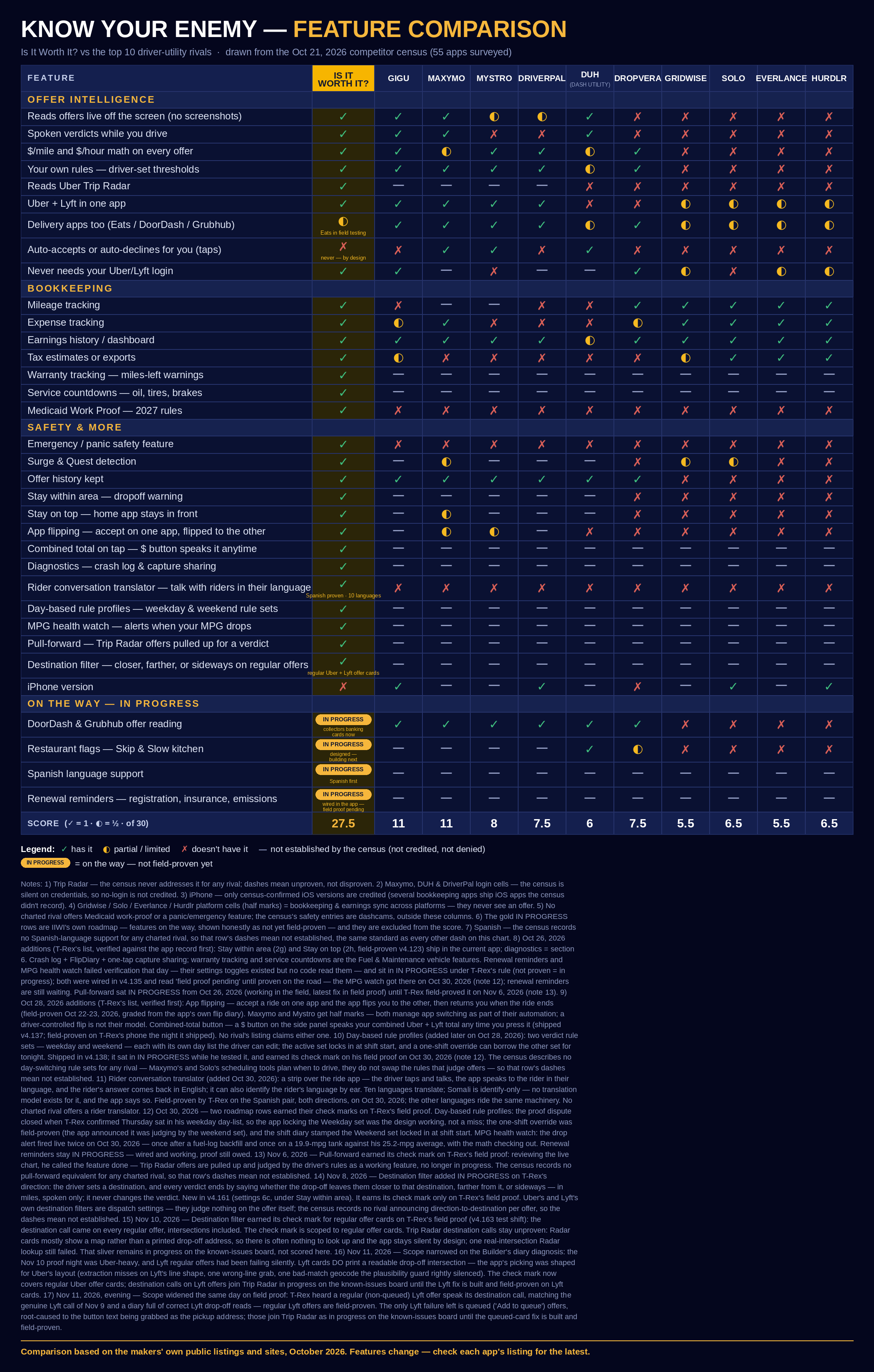
Tap the chart to view it full size.